Road construction is not only about the visible asphalt or concrete surface. Beneath the finished pavement, several layers work together to provide stability, distribute loads and support long-term performance. Road base material is an important part of this pavement structure.
For contractors working on roads, parking areas, access routes, industrial yards and other civil construction projects, the right base material can help create a stable foundation for the surface layer above it. Graded aggregate materials used for bases and subbases are intended to provide stability and load support when properly placed and compacted according to the project requirements. ASTM D2940/D2940M covers graded aggregate materials for highway and airport bases or subbases and highlights the importance of proper spreading and compaction.
In Dubai, construction projects range from private developments and commercial buildings to industrial facilities, road works and infrastructure projects. Road base may be required at different stages of these developments, but material selection should always follow the project’s drawings, engineering requirements and applicable specifications.
This guide explains what road base materials do, where they are used and what contractors should consider when sourcing them from a road base supplier in Dubai.
What Is Road Base Material?
Road base is a graded granular construction material used as a supporting layer beneath pavement or other finished surfaces.
Depending on the project specification, it can contain combinations of crushed stone, gravel and finer particles. Its grading is important because the material needs to be capable of being spread and compacted into a stable and consistent layer.
ASTM D2940/D2940M describes quality-controlled graded aggregates intended for highway or airport bases and subbases. When properly spread and compacted on a prepared grade, these materials can provide stability and load support.
The exact composition, grading and performance requirements of road base can vary from one project to another. Contractors should therefore confirm the required specification before ordering material.
Why Is Road Base Important?
A finished road surface carries traffic, but the layers beneath it help transfer and distribute those loads into the underlying ground.
A properly designed and constructed base layer can:
- Provide a stable platform for pavement
- Help distribute loads over the underlying ground
- Support asphalt, concrete or other approved finished surfaces
- Improve the consistency of the pavement foundation
- Provide a suitable layer for compaction and grading
- Support the construction process before the final surface is installed
Road base should therefore be considered part of the overall pavement system rather than simply general filling material.
Road Base vs Sub-Base
Road base and sub-base are related, but they are not necessarily the same layer.
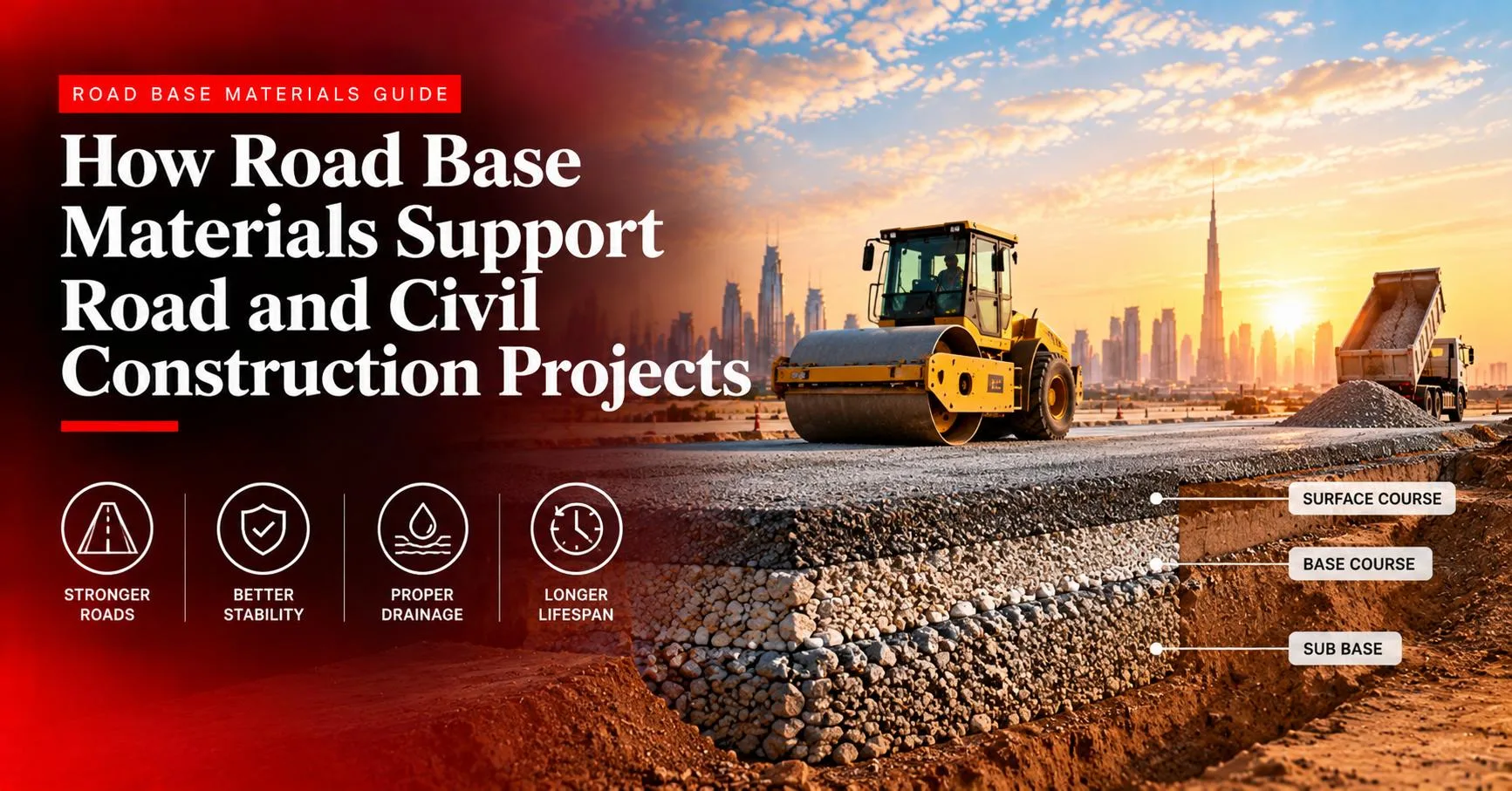
The sub-base is generally positioned above the prepared subgrade and below the base course. The base course is typically closer to the finished pavement and plays an important role in supporting the pavement structure.
The exact arrangement depends on the pavement design, site conditions and engineering requirements.
For this reason, contractors should not assume that any aggregate material can be used interchangeably as road base, sub-base or general fill. The required material should be selected according to the project’s approved specifications.
How Road Base Supports Road Construction
Road construction involves several stages, and the base material has an important role between ground preparation and the finished pavement.
Creating a Stable Foundation
Before asphalt, concrete paving or another finished surface is installed, the underlying structure needs to provide an appropriate foundation.
Road base can be spread over the prepared formation or subgrade and compacted to create a more uniform supporting layer where specified by the pavement design.
The required thickness, density and construction method will depend on the project.
Distributing Traffic Loads
Vehicles place repeated loads on a road surface. These loads move through the pavement structure and into the ground below.
A properly designed base layer helps distribute these loads through the pavement system rather than leaving the finished surface to carry the load on its own.
This is one reason graded aggregate materials are commonly used in pavement base construction.
Supporting the Pavement Surface
Road base can provide the supporting layer beneath asphalt, concrete paving or other approved surface systems.
Before the next construction layer is installed, the base needs to meet the required level, density, stability and surface requirements specified for the project.
Providing a Consistent Working Platform
A properly prepared base can also provide a more uniform platform for subsequent construction activities.
This can be useful when the next stage involves asphalt paving, concrete placement, interlocking pavers or another finished surface.
Common Applications of Road Base Materials
Road base is used in more than traditional public roads. Depending on the project specification, it can support a range of civil and construction applications.
Road Construction
Roads are one of the primary applications for base materials.
Road base may form part of the pavement structure beneath the finished road surface. The required grading, thickness and compaction depend on the road design and applicable specifications.
For major projects, contractors should follow the relevant authority and project requirements rather than relying on a generic road base specification.
Parking Areas
Parking areas experience repeated vehicle loading and require a suitable foundation beneath the finished surface.
Road base can be used as part of the prepared pavement structure where specified. Material selection and compaction requirements should take into account the expected loading and final pavement design.
Access Roads and Site Roads
Construction sites, industrial areas and new developments may require temporary or permanent access roads.
A suitable granular base can provide a stable working surface or form part of the foundation system, depending on the project design.
Traffic loading, drainage, ground conditions and intended duration of use should all be considered.
Industrial Yards and Hardstanding Areas
Industrial facilities may require hardstanding areas for vehicles, equipment, storage or operational activities.
Road base can form part of the foundation beneath the final hardstanding surface where specified. Expected vehicle loads and site usage should be considered during pavement design and material selection.
Driveways and External Areas
Residential and commercial developments may require driveways, service routes and other external paved areas.
The appropriate base material depends on the final surface, underlying ground conditions, expected traffic and project specifications.
Civil Infrastructure Projects
Road base materials can also be part of broader civil infrastructure work.
These projects may involve:
- Access routes
- Service roads
- Paved areas
- Site development
- Utility-related reinstatement
- External construction areas
The exact material requirements should always come from the project’s engineering documentation.
Why Grading Matters in Road Base
One of the important characteristics of road base material is its grading.
Grading refers to the distribution of different particle sizes within the material. A properly specified aggregate can be placed and compacted to create the required layer.
ASTM D2940/D2940M includes requirements and testing related to graded aggregate materials for bases and subbases, while aggregate sieve analysis is used to determine particle-size distribution and assess compliance with applicable specifications.
This means contractors should not select road base simply by looking at its appearance.
The material needs to match the specification required for the particular application.
The Importance of Compaction
Road base does not achieve its intended function simply because it has been delivered to the site.
It normally needs to be properly placed, moisture-conditioned where required and compacted according to the project’s approved construction requirements.
ASTM D2940/D2940M specifically connects the expected stability and load-support characteristics of graded aggregate base material with proper spreading and compaction.
The construction team should therefore follow the approved method statement and engineering requirements for:
- Layer thickness
- Moisture condition
- Compaction equipment
- Number of passes
- Required density
- Finished level
- Surface tolerance
These requirements can vary from one project to another.
What to Consider When Buying Road Base in Dubai
Selecting a road base supplier in Dubai should involve more than comparing the price per load.
1. Understand the Project Requirement
Before contacting a supplier, identify where the material will be used.
Is it for:
- A road?
- Parking area?
- Industrial yard?
- Access route?
- Civil works?
- Sub-base?
- Base course?
The application helps determine what material specification is required.
2. Confirm the Required Grading
Ask the project engineer or consultant for the required grading before placing an order.
Different projects may require different aggregate sizes or grading ranges, so the supplier should be given the correct specification.
3. Check Material Quality
The supplier should be able to provide clear information about the material being supplied.
For larger or specification-sensitive projects, contractors may also need relevant test results or material documentation as required by the project.
4. Calculate the Required Quantity
Road base is generally purchased in bulk, making quantity planning important.
The required volume may depend on:
- Area to be covered
- Required layer thickness
- Material density
- Site conditions
- Project wastage allowance where applicable
Final quantities should be confirmed using approved project measurements and engineering requirements.
5. Plan Delivery
Road base can be required in substantial quantities, particularly for road and infrastructure projects.
Before ordering, confirm:
- Number of loads required
- Delivery location
- Preferred delivery schedule
- Site access
- Unloading arrangements
- Availability for repeat deliveries
A supplier with suitable delivery capacity can help coordinate material movement with site progress.
Road Base Supply for Large Civil Construction Projects
Large construction projects often require a continuous supply of materials rather than a single delivery.
For example, a road construction project may require road base across multiple sections of a site. Deliveries may need to be coordinated with grading, spreading and compaction activities.
A planned supply schedule can help reduce interruptions between material placement and the next stage of construction.
This is where choosing an experienced construction material supplier can make procurement easier. Falcon Fame Trading supports contractors, developers and construction-related businesses in Dubai and the UAE with road base and other construction material requirements.
With 36+ years of experience, 30+ delivery vehicles, 3–45 CBM delivery capacity and 24/7 operational capability, Falcon Fame Trading is positioned to support projects where material availability and scheduled delivery are important.
Road Base Supply in Dubai
Dubai’s construction sector includes residential developments, commercial buildings, industrial facilities, road works and wider infrastructure projects. Each type of project can have different material requirements.
For this reason, road base should be sourced according to the actual project specification rather than using a one-size-fits-all approach.
Falcon Fame Trading, based in Al Quoz Industrial Area 3, Dubai, supplies road base as part of its wider construction material range. The company works with contractors, developers, technical service providers and other construction-related businesses for material procurement and delivery.
Its broader product range includes:
- Cement
- Concrete blocks
- Dry mix
- Aggregates
- Sand bags
- Road base
- Gypsum products
- Cement and construction boards
- MDF boards
For projects requiring coordinated deliveries, Falcon Fame Trading’s 30+ delivery vehicles and 24/7 operational capability provide logistical support alongside its material supply services.
How to Choose a Road Base Supplier in Dubai
A suitable supplier should be able to answer practical questions before you place an order.
Ask the supplier:
- What type of road base is available?
- What grading options are available?
- Is the material suitable for the intended application?
- What quantity can be supplied?
- What documentation is available?
- How quickly can delivery be arranged?
- Can repeat deliveries be scheduled?
- Can the supplier support larger project quantities?
- What delivery vehicle options are available?
Clear answers to these questions can make procurement easier and reduce the risk of ordering material that does not match the project requirement.
For contractors looking for a road base supplier in Dubai, it is also useful to consider the supplier’s broader material range. Working with a supplier that can support multiple construction material requirements may simplify procurement when several materials are needed across different project stages.
Common Road Base Procurement Mistakes
Choosing Based Only on Price
A lower price does not necessarily mean a lower overall project cost if the material does not meet the required specification or the delivery schedule does not match site requirements.
Using the Wrong Material
Road base, sub-base, general aggregate and fill material can have different purposes.
The project specification should determine which material is required.
Ignoring Compaction Requirements
Even suitable material may not perform as intended if placement and compaction are not carried out according to the approved construction method.
Ordering Too Late
For large projects, waiting until road base is urgently needed can create unnecessary delivery pressure.
Advance planning is particularly useful when material is required across multiple construction stages.
Not Confirming Delivery Capacity
A supplier may have material available but insufficient delivery capacity for the project’s required schedule.
For bulk requirements, confirm both material availability and logistics before finalising the order.
Road Base and Overall Project Planning
Road base procurement should form part of the project’s broader material planning.
For a road or civil construction project, contractors may need aggregates, sand, cement, concrete products and other materials at different stages. Coordinating these requirements can make site logistics easier.
When discussing road base with a supplier, provide as much information as possible about:
- Project location
- Intended application
- Required grading
- Estimated quantity
- Required delivery period
- Site access conditions
This gives the supplier a clearer understanding of what is required and allows delivery planning to be discussed before the material is urgently needed.
Need Road Base Material in Dubai?
If your project requires road base material in Dubai, start by confirming the required specification with the project engineer, consultant or procurement team.
Once the requirement is clear, share the material type, grading, estimated quantity, delivery location and required schedule with your supplier.
Falcon Fame Trading can support road base and broader construction material requirements across Dubai and the UAE. With its location in Al Quoz Industrial Area 3, wide construction material range, 30+ delivery vehicles and 24/7 operational capability, the company can support contractors and project teams with material procurement and delivery requirements.
For project enquiries, contractors can contact Falcon Fame Trading to discuss road base requirements, quantities and delivery planning.
Conclusion
Road base materials play an important role in road and civil construction by forming a supporting layer beneath finished pavement and other external surfaces. Their performance depends not only on the material itself but also on correct grading, placement, moisture conditioning and compaction.
For contractors, selecting the right road base starts with understanding the project’s engineering requirements. Application, grading, quantity, material quality and delivery planning should all be considered before procurement.
When sourcing from a road base supplier in Dubai, it is also important to look beyond the material price and consider supply capacity, documentation, delivery reliability and the supplier’s ability to support the project schedule.
With 36+ years of construction material supply experience, 30+ delivery vehicles and 24/7 operational capability, Falcon Fame Trading supports road base and wider construction material requirements across Dubai and the UAE.
The right material, correct construction practices and a well-planned supply schedule can help create the stable foundation required for roads, parking areas, industrial yards, access routes and other civil construction applications.
Frequently Asked Questions
1. What is road base material used for?
Road base is used as a supporting layer in road and pavement construction and can also be specified for parking areas, access roads, industrial yards, hardstanding areas and other civil works.
2. What is the difference between road base and sub-base?
Road base and sub-base are different layers within a pavement structure. The exact arrangement depends on the project design, but sub-base is generally below the base course and above the prepared subgrade.
3. Why is compaction important for road base?
Compaction helps granular material achieve the required density and stability. Proper spreading and compaction are important to the expected performance of graded aggregate base materials.
4. How do I choose the right road base material?
Consider the application, required grading, layer thickness, project specification, quantity and expected loading. The material should be selected according to the approved engineering requirements.
5. Where can I buy road base material in Dubai?
Road base can be sourced from construction material suppliers in Dubai. Before ordering, confirm the required grading, quantity, material documentation and delivery capacity with the supplier. Falcon Fame Trading supplies road base as part of its wider construction material range and supports delivery requirements across Dubai and the UAE.