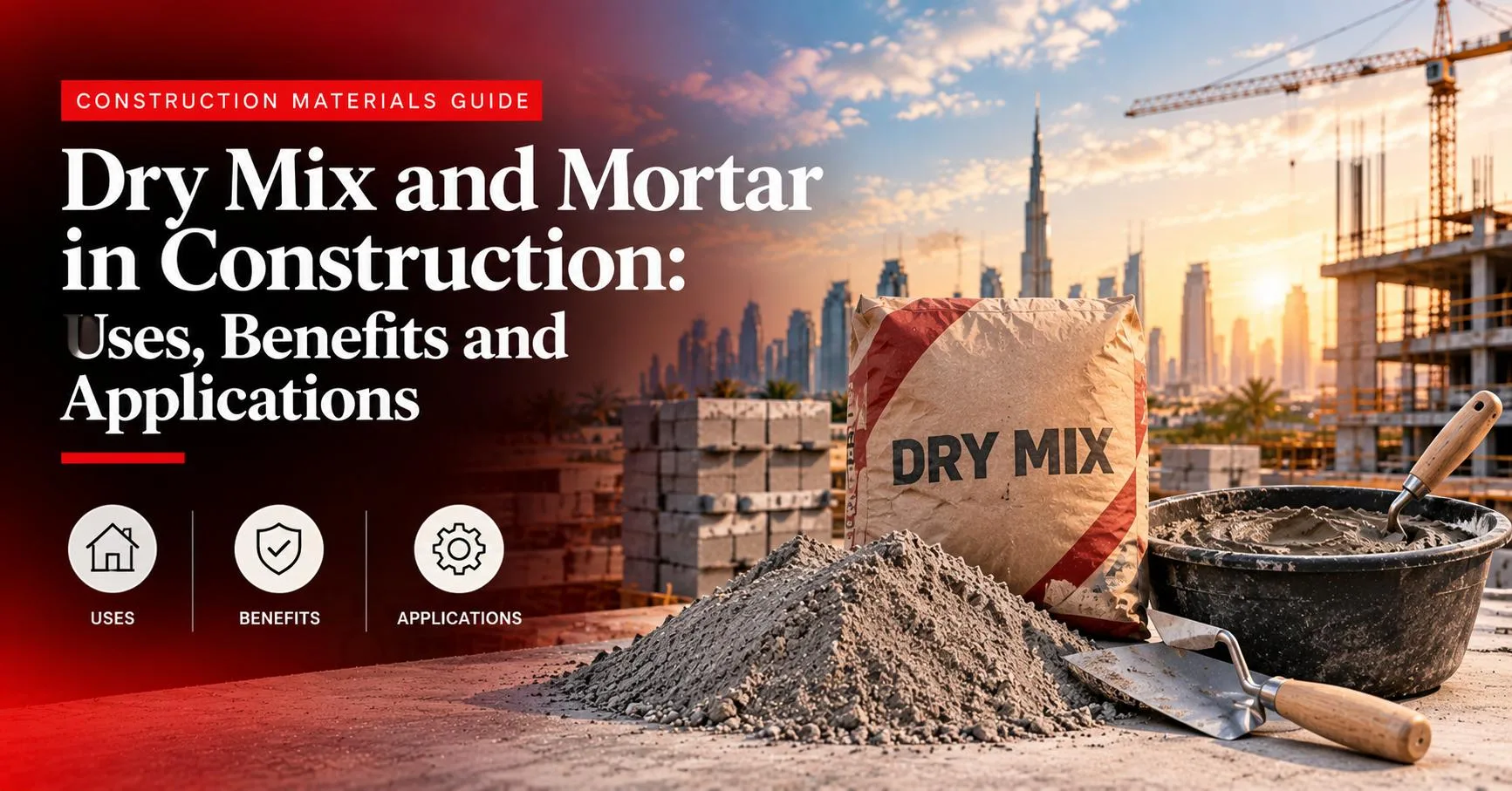
Construction work involves many materials that need to come together at the right time and in the right proportion. Mortar is one of them. It is used in masonry, block laying, plastering, repairs, and several other construction and finishing applications.
Traditionally, mortar can be prepared at the construction site by combining cement, sand, water, and other required materials. Dry mix products offer a more controlled and convenient approach because the dry ingredients are prepared and supplied as a ready formulation, with water added according to the product requirements at the site.
For contractors and construction companies looking for a dry mix supplier in Dubai, understanding how dry mix and mortar work, where they are used, and what to consider before buying can make material procurement much easier. For projects that require multiple construction materials, working with a supplier such as FALCON FAME TRADING can also help bring different material requirements under one procurement arrangement.
What Is Dry Mix?
Dry mix is a pre-prepared construction material supplied in dry form. Depending on the product, it can contain cementitious materials, aggregates, fillers, and other components required for a particular application.
The exact formulation varies according to the intended use.
Instead of measuring individual dry ingredients separately at the construction site, a prepared dry mix provides a formulated material that can be mixed with the specified amount of water before application.
This approach can make material preparation more convenient and can help maintain consistency when the product is handled and mixed according to the manufacturer’s instructions.
For contractors, the key point is that dry mix is not one single product for every construction activity. The formulation and intended application should be confirmed before ordering.
What Is Mortar?
Mortar is a construction material used primarily to join masonry units or provide a cement-based layer or finish, depending on its formulation and application.
Cement acts as a binding material, and when combined with suitable aggregates and water, cement-based mixtures can be used to produce mortar and other construction materials.
Mortar is commonly associated with brick and block masonry, but mortar-based materials are also used in different construction and finishing applications.
The right mortar depends on what the material is expected to do.
For example, mortar selected for block laying may have different requirements from a material intended for plastering, rendering, repair, or another application.
Dry Mix and Mortar: Are They the Same?
Not exactly.
Dry mix describes the way a prepared construction material is supplied and formulated before water is added.
Mortar describes a type of cement-based construction material and its intended application.
A dry mix product can be formulated specifically to produce mortar for a particular use.
This distinction is useful when buying construction materials because simply asking for “dry mix” may not provide enough information for a supplier to identify the right product.
The intended application should always be discussed first.
When approaching a dry mix supplier in Dubai, contractors should therefore provide details about the construction activity, quantity, project location, and any applicable material specification.
Common Uses of Dry Mix and Mortar
Dry mix and mortar products can be used in several areas of construction.
Masonry Work
Mortar is widely used between masonry units such as concrete blocks and other masonry products.
It helps create the connection between individual units and forms part of the completed masonry system.
For blockwork, the mortar should be selected according to the block type, wall design, project requirements, and applicable specification.
Block Laying
Concrete blocks need an appropriate bedding and jointing material during installation.
A suitable mortar can help create consistent joints between blocks when correctly mixed and applied.
For contractors working with solid or hollow concrete blocks, choosing the mortar according to the masonry specification is important rather than using one general mix for every application.
Where a project also requires concrete blocks, cement, or other materials, coordinating these requirements with the same construction material supplier can simplify procurement.
Plastering and Rendering
Certain dry-mix products are formulated for plastering, rendering, or related surface applications.
These products can be prepared for use by adding the specified amount of water and mixing according to the manufacturer’s instructions.
The exact product should match the required finish and substrate.
Repair and Maintenance Work
Some mortar and dry-mix formulations can be used for repair or maintenance applications.
These may include repairing masonry, filling selected areas, or carrying out other cement-based repair work.
The repair material should be selected according to the condition of the surface and the type of repair required.
Construction and Finishing Work
Dry-mix materials can also be used in different construction and finishing applications depending on their formulation.
This is why product selection matters. A material intended for masonry should not automatically be treated as suitable for plastering or another application.
Why Contractors Use Dry Mix
One of the main advantages of dry mix is convenience.
Instead of bringing multiple dry ingredients to the site and measuring them separately, a prepared product can simplify the mixing process.
More Consistent Mixing
When a product is manufactured with a defined formulation, the dry components are prepared before they reach the construction site.
This can help reduce variations that may occur when individual ingredients are measured manually.
Of course, the final result still depends on correct water addition, mixing, handling, and application.
Easier Material Handling
A prepared dry product can be easier to manage from a procurement and site-handling perspective.
The contractor can order the required product according to the application instead of separately arranging every component needed to prepare a particular mix.
Better Procurement Planning
Dry mix can also make material planning more straightforward.
Instead of estimating separate quantities of cement, sand, and other ingredients for every application, contractors can plan their requirement around the selected dry-mix product.
For larger projects, this becomes particularly useful when material requirements need to be scheduled along with blockwork, plastering, finishing, or other construction activities.
Suitable for Repeated Work
For projects involving repeated masonry or finishing work, using a consistent prepared product can help simplify day-to-day material preparation.
This can be particularly useful on larger projects where several teams may be working on similar applications.
What Should You Consider When Buying Dry Mix?
Choosing a dry mix supplier in Dubai should start with the application, not the product name.
Before placing an order, consider the following.
1. Know the Application
Tell the supplier what the material will be used for.
For example:
- Block laying
- Masonry
- Plastering
- Rendering
- Repair work
- Other specified applications
Different applications can require different formulations.
Providing the application at the enquiry stage helps the supplier understand what type of dry mix or mortar is actually required.
2. Check the Project Specification
If the project has an approved material specification, follow it.
Commercial and large-scale construction projects may have requirements set by consultants, engineers, architects, or project management teams.
The dry mix should be selected according to those requirements.
3. Ask About Mixing Requirements
Dry mix does not mean that no preparation is required.
Water normally needs to be added according to the product instructions.
Ask the supplier or manufacturer about:
- Required water quantity
- Mixing method
- Mixing time
- Application method
- Working time
- Storage conditions
Do not add water simply based on how the material looks during mixing.
4. Consider Coverage and Quantity
Before ordering, estimate how much material the project will require.
The actual consumption can depend on:
- Application
- Surface area
- Layer thickness
- Joint thickness
- Substrate condition
- Product formulation
- Application method
For larger projects, quantity planning should be based on the actual application rather than a general estimate.
Sharing the expected quantity and project schedule with the supplier can also help with delivery planning.
5. Check Packaging
Dry mix products are generally supplied in bags or other suitable packaging.
Before ordering, confirm the available pack size and calculate the total number of bags or units required.
For large projects, packaging can also affect storage and handling requirements.
Dry Mix for Residential Projects
Residential construction involves many applications where mortar and dry-mix products may be required.
These can include masonry, blockwork, plastering, repairs, and finishing work.
A villa or residential building may require different products at different stages, so it is better to plan the material requirement according to the construction schedule.
For smaller projects, accurate quantity planning can also help avoid storing unnecessary material at the site.
Where the project also requires cement, concrete blocks, sand, aggregates, or other materials, a supplier with a broader product range can make procurement more convenient.
Dry Mix for Commercial Projects
Commercial construction projects can involve larger quantities and more coordinated material requirements.
Offices, retail spaces, hotels, warehouses, and other commercial buildings may use mortar and dry-mix materials across different construction stages.
For these projects, procurement teams should consider:
- Approved product specification
- Application
- Required quantity
- Delivery frequency
- Site storage
- Construction schedule
- Supplier capacity
A planned supply arrangement can be more practical than ordering material only when the site runs short.
For larger projects in Dubai, contractors may also benefit from discussing future requirements with their construction material supplier so that material deliveries can be planned around site progress.
Dry Mix for Renovation and Fit-Out Work
Renovation and fit-out projects often involve several smaller areas of work rather than one continuous construction activity.
Material requirements can therefore change as the project progresses.
Dry-mix products can be useful where contractors need a prepared material for specific masonry, plastering, repair, or finishing applications.
The product should still be selected according to the surface and intended application.
Since renovation projects can have changing quantities and delivery requirements, clear communication with the supplier is particularly useful.
How to Store Dry Mix and Mortar Products
Storage is an important part of material management.
Dry products should be kept protected from moisture and unsuitable site conditions. If the packaging becomes exposed to water or dampness, the material may no longer be in the intended condition for use.
Before receiving a large delivery, make sure the site has:
- Dry storage space
- Protection from rain and moisture
- Properly organised material storage
- Easy access for handling
- Sufficient space for the expected quantity
Following the product’s storage instructions is particularly important when material is being kept at the site for an extended period.
Good storage planning should therefore be considered when deciding the quantity and delivery frequency.
Dry Mix vs Traditional Site-Mixed Mortar
Both approaches can be used in construction, but the way the material is prepared is different.
With traditional site mixing, workers measure and combine individual ingredients at the project site.
With a prepared dry mix, the formulation is produced before delivery and the required water is added at the site.
For contractors, the choice can depend on the application, project size, required consistency, labour arrangements, available equipment, storage, and project specifications.
Dry mix should therefore not be considered a universal replacement for every site-mixed material.
The appropriate approach depends on the specific construction requirement.
Why Supplier Selection Matters
When purchasing dry mix in Dubai, the supplier should understand the application and the project requirement.
A useful supplier should be able to discuss:
- Available dry-mix products
- Intended applications
- Packaging
- Quantity
- Delivery options
- Storage considerations
- Project requirements
This becomes especially important when a contractor is buying material for a larger project.
A supplier that can provide several construction materials can also simplify procurement when the same project requires cement, blocks, aggregates, sand bags, gypsum products, or road base alongside dry mix.
For contractors in Dubai, FALCON FAME TRADING offers dry mix and mortar alongside a broader range of construction materials, allowing different material requirements to be discussed under one supplier.
What to Ask a Dry Mix Supplier in Dubai
Before confirming an order, ask a few practical questions.
What application is the product designed for?
This helps ensure that the selected dry mix matches the intended work.
What is the required water ratio?
Follow the product’s recommended mixing instructions rather than estimating the water quantity.
How much area will one bag cover?
Coverage depends on application and thickness, so confirm the expected consumption for your specific work.
What packaging sizes are available?
This helps with quantity planning and storage.
What are the storage requirements?
Confirm how the product should be protected at the construction site.
Can the supplier support the required quantity?
For large projects, ask about current availability and future supply.
Can the material be delivered to the project location?
Discuss delivery timing, access, and unloading requirements before confirming the order.
Dry Mix Supply from FALCON FAME TRADING
FALCON FAME TRADING supplies dry mix and mortar as part of its construction material range in Dubai.
The company works with contractors, developers, technical service providers, and other construction-related businesses for material procurement and delivery requirements.
Along with dry mix and mortar, its construction material range includes:
- OPC Cement
- PLC Cement
- MC2/Masonry Cement
- White Cement
- Solid and Hollow Concrete Blocks
- Construction Aggregates
- Sand Bags
- Gypsum Powder and Gypsum Products
- Road Base
- Cement Boards
- Gypsum Boards
- MDF Boards
Based in Al Quoz Industrial Area 3, Dubai, FALCON FAME TRADING has 36+ years of experience in construction material supply, operates with 30+ delivery vehicles, and provides 24/7 delivery operations.
Its delivery capability ranges from 3 CBM to 45 CBM, supporting different project sizes and material delivery requirements.
For a dry-mix requirement, customers can share the intended application, required quantity, project location, and expected delivery schedule so that the material requirement can be discussed clearly.
This is particularly useful for projects where dry mix forms part of a larger construction material order.
Planning Dry Mix for a Large Project
Large projects benefit from planning material requirements before the site reaches the point of shortage.
Start by identifying where dry mix or mortar will be used and estimate the expected consumption for each construction stage.
Then consider:
- Product type
- Quantity
- Packaging
- Delivery frequency
- Storage capacity
- Construction schedule
If the project is expected to run for several months, discuss future supply requirements with the supplier in advance.
For projects sourcing multiple materials, discussing dry mix requirements together with cement, blocks, aggregates, sand, or other materials can also make procurement coordination easier.
A Simple Buying Checklist
Before ordering dry mix or mortar, confirm:
- What application is the material for?
- Which product is specified?
- How much material is required?
- What pack size is available?
- What is the required mixing method?
- How should the product be stored?
- When does the site need the material?
- Does the supplier have sufficient stock or supply capacity?
- Can delivery be arranged according to the project schedule?
- Are future material requirements likely?
A few minutes spent confirming these details can prevent confusion later at the construction site.
Why Choose FALCON FAME TRADING for Dry Mix Supply?
For contractors looking for a dry mix supplier in Dubai, supplier capability is important beyond simply finding a product.
FALCON FAME TRADING supports construction material procurement with:
- 36+ years of experience in construction material supply
- Dry mix and mortar as part of its product range
- A wider selection of construction materials
- 30+ delivery vehicles
- 3–45 CBM delivery capacity
- 24/7 delivery operations
- Supply support from Al Quoz Industrial Area 3, Dubai
- Support for contractors, developers, technical service providers, and other construction-related businesses
This broader supply capability can be useful when dry mix is required alongside other materials for the same project.
Conclusion
Dry mix and mortar are important materials for many construction and finishing activities, from masonry and block laying to plastering, rendering, repair, and other applications.
The main benefit of a prepared dry mix is that the dry formulation is prepared before it reaches the site, which can simplify material handling and mixing. However, the right product still depends on the intended application, project specification, mixing requirements, quantity, storage, and delivery schedule.
For contractors looking for a dry mix supplier in Dubai, it is important to explain the actual construction requirement rather than simply asking for a general dry-mix product.
FALCON FAME TRADING supplies dry mix and mortar along with cement, concrete blocks, aggregates, sand bags, gypsum products, road base, and other construction materials across Dubai and the UAE.
With 36+ years of experience, 30+ delivery vehicles, 3–45 CBM delivery capacity, and 24/7 delivery operations, FALCON FAME TRADING supports construction material procurement for different project requirements.
Sharing the application, quantity, project location, and delivery schedule before ordering can make the procurement process more organised and help ensure that the selected material aligns with the actual construction requirement.
Frequently Asked Questions
1. What is dry mix used for in construction?
Dry mix is used for different construction applications depending on its formulation. Products can be designed for masonry, block laying, plastering, rendering, repair work, and other cement-based applications.
2. What is the difference between dry mix and mortar?
Dry mix refers to a prepared dry construction formulation, while mortar refers to a cement-based material used for applications such as masonry and other construction work. A dry mix can be specifically formulated to produce mortar for a particular application.
3. How much water should be added to dry mix?
The required amount of water depends on the specific product and application. Contractors should follow the manufacturer’s recommended mixing instructions rather than adding water based on estimation.
4. How should dry mix be stored at a construction site?
Dry mix should generally be protected from moisture and stored according to the product’s instructions. The storage area should be dry, protected, and suitable for keeping the material in its intended condition.
5. Where can I buy dry mix in Dubai?
FALCON FAME TRADING supplies dry mix and mortar in Dubai along with cement, concrete blocks, aggregates, sand bags, gypsum products, road base, and other construction materials. Contractors can share their application, quantity, project location, and delivery requirement to discuss the appropriate supply arrangement.