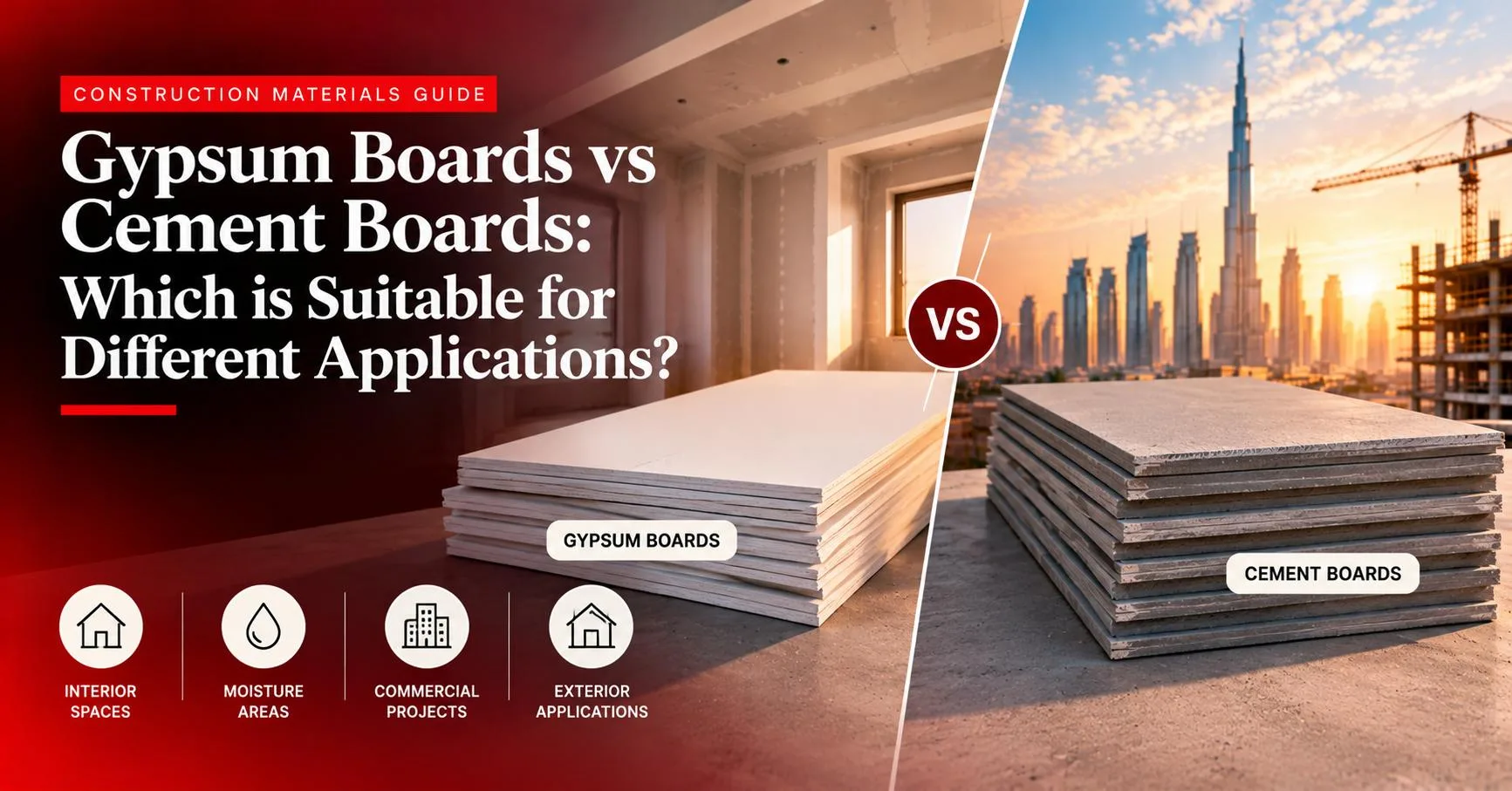
Choosing the right board can make a significant difference to the performance and finish of an interior construction project. Gypsum boards and cement boards are both widely used in walls, ceilings, partitions, and other building applications, but they are not designed for exactly the same conditions.
A gypsum board may be a practical choice for an interior partition or ceiling, while a cement board may be more appropriate where the substrate needs greater resistance to moisture or where tile and other finishes are involved.
For contractors, architects, fit-out teams, and procurement professionals looking for gypsum board in Dubai, understanding the difference between these two materials can make product selection easier. The right choice should always depend on the application, site conditions, project specification, and the type of finish required.
For projects where several construction materials need to be sourced together, working with an experienced construction material supplier can also simplify procurement. FALCON FAME TRADING supplies gypsum boards and cement boards along with other construction materials for projects across Dubai and the UAE.
What Is Gypsum Board?
Gypsum board is a panel product with a gypsum-based core and a facing, commonly paper. ASTM C1396/C1396M-24 covers several gypsum board products, including wallboard for walls, ceilings, and partitions, backing board, shaftliner board, water-resistant gypsum backing board, gypsum sheathing, and ceiling board.
Because different gypsum boards are designed for different purposes, the term “gypsum board” does not describe only one product.
Depending on the specification, gypsum boards can be used for:
- Interior walls
- Partitions
- Ceilings
- Decorative surfaces
- Shaft wall assemblies
- Certain tile backing applications
- Selected protected exterior applications
The board should always be selected according to the conditions in which it will be installed.
What Is Cement Board?
Cement board is a rigid cementitious panel used as a substrate in construction and finishing applications.
Certain cementitious backer boards are designed to provide a dimensionally stable substrate for materials such as tile and natural stone. ASTM C1325 covers fiber-mat reinforced cementitious backer units used as substrates for decoration such as natural stone or tile on walls, floors, or decks in wet and dry areas, depending on the product and application.
Cement board products can therefore be useful where the installation requires a cementitious substrate rather than a conventional gypsum wall surface.
As with gypsum boards, the exact product specification matters. A contractor should confirm the intended application before ordering.
Gypsum Board vs Cement Board: The Basic Difference
The biggest difference is the type of board and the environment in which it is intended to perform.
Gypsum boards are commonly selected for interior walls, ceilings, and partitions where a finished surface is required. Cement boards are commonly considered where a stable cementitious substrate is required, particularly for tile, stone, and certain moisture-exposed applications.
This does not mean that every gypsum board is unsuitable for moisture or that every cement board is suitable for every wet application. Different products have different specifications.
The application should always determine the material.
Where Is Gypsum Board Commonly Used?
Interior Walls
Gypsum board is widely used for interior wall systems. It can be installed over suitable framing to create partitions and finished wall surfaces.
Its smooth surface can also provide a suitable base for decoration and finishing. ASTM C1396/C1396M-24 specifically identifies gypsum wallboard for walls, ceilings, and partitions.
Partition Walls
Gypsum boards are commonly used in partition systems for offices, homes, commercial spaces, hotels, and other interior areas.
They can help divide a larger space into separate rooms without constructing conventional masonry walls.
The complete partition system may include framing, insulation, fasteners, joint treatment, and other components depending on the design.
Interior Ceilings
Gypsum ceiling boards can be used for interior ceiling systems.
They provide a finished surface that can be decorated after installation. For offices, residential interiors, retail spaces, and hospitality projects, gypsum board ceilings can form part of the overall interior finishing system.
Drywall and Fit-Out Applications
Gypsum boards are particularly relevant to modern dry construction and interior fit-outs.
They can be used to create walls, partitions, bulkheads, ceiling features, and other interior elements.
For renovation and fit-out contractors, the correct board specification can be important because different areas of the same project may require different board types.
Where Is Cement Board Commonly Used?
Tile Backing
One of the important applications of cement board is providing a suitable substrate for tile and similar finishes.
Cementitious backer units covered by ASTM C1325 can be used as substrates for natural stone or tile in wet and dry areas, subject to the product’s intended application.
This makes cement board a common consideration where a stable cementitious backing is required.
Wet-Area Applications
Certain cementitious boards are designed for wet-area applications.
They can be used in suitable wall, floor, or deck assemblies depending on the specific product. However, “cement board” should not automatically be treated as waterproof or suitable for every wet environment.
The complete system, installation method, waterproofing requirements, and product specification must be considered.
Areas Requiring a Stable Substrate
Cementitious backer boards can be useful where the finish requires a dimensionally stable substrate.
This can be relevant for tile, stone, coatings, and similar finishing systems. The appropriate board depends on the intended finish and installation requirements.
Selected Exterior or Covered Applications
Some cementitious board products are designed for exterior or covered applications.
The product’s technical documentation should always be checked before using cement board outdoors. The term “cement board” alone is not enough to determine whether a product is suitable for a particular exterior environment.
Gypsum Board vs Cement Board for Interior Walls
For a standard dry interior partition, gypsum board is often the type of product considered first.
It is designed specifically for walls and partitions and can provide a finished surface suitable for decoration.
Cement board can also be used in wall systems, but it is generally considered when the project requires a cementitious substrate or specific resistance characteristics associated with the intended application.
For example, a normal office partition and a tiled wet-area wall may require very different board systems.
The application should come before the material choice.
Which Board Is Better for Ceilings?
The answer depends on the ceiling location and conditions.
For Standard Interior Ceilings
Gypsum board is commonly used for interior ceilings because gypsum ceiling board is specifically covered within the gypsum board standard. ASTM C1396/C1396M-24 includes gypsum ceiling board for interior ceiling applications.
It can provide a smooth surface for painting and other decorative finishes.
For Moisture-Prone or Special Applications
Where a ceiling or soffit is exposed to specific moisture or environmental conditions, the board must be selected according to the manufacturer’s approved application.
Some gypsum products are designed for protected exterior soffits, while cementitious products may be specified for other demanding conditions.
Therefore, simply choosing cement board because an area is “difficult” is not enough. The complete specification should determine the material.
Which Board Is Better for Bathrooms?
Bathrooms require more careful material selection than a normal dry room.
The important consideration is not simply whether a board is labelled gypsum or cement.
A contractor should consider:
- Where the board will be installed
- Whether it will receive tile
- Moisture exposure
- Waterproofing system
- Substrate requirements
- Manufacturer’s installation instructions
- Project specifications
Certain water-resistant gypsum backing boards are designed as backing for ceramic or plastic tile on walls or ceilings. ASTM C1396/C1396M-24 specifically includes water-resistant gypsum backing board for these applications.
Cementitious backer boards are also used as substrates for tile and natural stone in wet areas, depending on their specification.
So the choice should be made based on the complete wall or ceiling system rather than the board material alone.
Which Board Is Better for Tile?
For tile installations, cement board is often considered when the project requires a cementitious backer substrate.
Its intended use as a substrate for tile and natural stone is covered by cementitious backer-unit standards.
However, certain water-resistant gypsum backing boards are also designed for use behind ceramic or plastic tile.
The key question is:
What backing system does the project specification require?
The tile type, location, moisture exposure, waterproofing method, and manufacturer’s installation requirements should all be checked.
Gypsum Board vs Cement Board for Commercial Fit-Outs
Commercial fit-out projects can use both materials in different areas.
An office partition may use gypsum board, while a tiled washroom or another specific area may require a cementitious board or a specified moisture-resistant gypsum system.
Hotels, restaurants, retail spaces, offices, and other commercial interiors may therefore use different board types within the same project.
Rather than selecting one board for the entire building, contractors should identify the requirements of each area.
For larger fit-out projects, procurement planning is also important. If gypsum boards, cement boards, gypsum powder, dry mix, or other construction materials are required together, sourcing them through an experienced supplier can make the material planning process easier.
Gypsum Board vs Cement Board for Residential Projects
Residential construction also involves different interior conditions.
Gypsum board can be used for:
- Bedroom partitions
- Living room walls
- Interior ceilings
- Decorative features
- Dry-area partitions
Cement board or another approved backing system may be considered for:
- Tiled areas
- Selected wet-area walls
- Specific substrate requirements
- Applications requiring a cementitious backing
Again, the exact product should match the intended application.
Important Factors Before Choosing a Board
1. Location
First determine where the board will be installed.
Is it an internal dry wall, ceiling, bathroom wall, tiled surface, exterior soffit, or another location?
2. Moisture Exposure
Moisture exposure can significantly affect material selection.
Do not assume that a standard gypsum board should be used in every area. Similarly, do not assume that every cement board provides complete waterproofing.
3. Final Finish
Consider what will be installed over the board.
The finish may be:
- Paint
- Tile
- Natural stone
- Decorative coating
- Other specified finish
The backing material should be compatible with the intended finish.
4. Structural and System Requirements
The board is only one part of a wall or ceiling system.
Framing, fasteners, joints, insulation, waterproofing, and finishing materials can all affect the final performance.
5. Project Specification
For commercial and larger construction projects, the consultant or project specification may already identify the required board type.
That requirement should take priority over a general product comparison.
Common Mistakes When Choosing Between Gypsum and Cement Board
Choosing Only on Price
The cheapest board may not be appropriate for the application.
A board that is unsuitable for the environment can create additional work later.
Treating All Gypsum Boards as the Same
There are different gypsum board products for different applications, including wallboard, backing board, shaftliner, water-resistant products, and ceiling boards.
Assuming Every Cement Board Is Waterproof
Cementitious boards can be suitable for certain wet-area substrate applications, but the board itself should not automatically be treated as a complete waterproofing system.
Ignoring the Finish
A board used behind tile may have different requirements from a board intended for a painted interior wall.
Not Checking Installation Requirements
Even the correct product can perform poorly if it is installed incorrectly.
Always follow the manufacturer’s installation instructions and project specifications.
How to Select the Right Board for Your Project
A simple approach is to work through the application step by step.
For a standard dry interior wall: consider the specified gypsum board system.
For a standard interior ceiling: gypsum ceiling board may be appropriate when specified for the application.
For a tiled wet-area substrate: compare the approved water-resistant gypsum or cementitious backer system specified for the project.
For areas requiring a cementitious substrate: consider the relevant cement board product and its approved application.
For exterior or exposed locations: check the product’s specific exterior approval rather than assuming either board is suitable.
This application-first approach is more reliable than asking which material is universally “better.”
Buying Gypsum Board in Dubai
When purchasing gypsum board in Dubai, contractors should provide the supplier with enough information to identify the required product.
Useful details include:
- Application
- Board type
- Thickness
- Dimensions
- Quantity
- Project location
- Required delivery date
- Required finish
- Any consultant or project specification
For larger projects, availability and delivery capacity should also be discussed in advance.
When the requirement includes multiple materials, it can also be practical to work with a supplier that handles several construction material categories.
Why Supplier Support Matters
Board procurement is easier when the supplier understands the project requirement.
A construction material supplier should be able to discuss available gypsum boards, cement boards, dimensions, quantities, packaging, availability, and delivery requirements.
For contractors managing several material categories, sourcing boards alongside other construction materials can also simplify procurement.
This is where an established supplier such as FALCON FAME TRADING can support the procurement process by supplying gypsum boards and cement boards alongside other commonly required construction materials.
Gypsum and Cement Board Supply from FALCON FAME TRADING
FALCON FAME TRADING supplies gypsum boards and cement boards as part of its wider construction material range in Dubai and the UAE.
The company’s product range also includes:
- Gypsum powder
- Cement
- Solid and hollow concrete blocks
- Dry mix and mortar
- Aggregates
- Sand bags
- Road base
- MDF boards
With 36+ years of experience in construction material supply, FALCON FAME TRADING works with contractors, developers, technical service providers, and other construction-related businesses.
The company operates from Al Quoz Industrial Area 3, Dubai, with 30+ delivery vehicles and 24/7 delivery operations to support different project supply requirements.
For projects requiring multiple materials, this broader product range can make procurement more convenient. Instead of arranging separate enquiries for every material category, customers can discuss their requirements based on the project scope and delivery schedule.
When requesting gypsum board or cement board, customers can share:
- Application
- Board type
- Required dimensions
- Thickness
- Quantity
- Project location
- Delivery schedule
- Any project-specific specification
Providing these details helps create a clearer material requirement before supply is arranged.
A Practical Checklist Before Ordering
Before confirming your board requirement, check:
- Where will the board be installed?
- Is the area dry, damp, or wet?
- Will the board receive paint, tile, stone, or another finish?
- Does the project specification identify a particular board?
- What thickness and dimensions are required?
- How many boards are needed?
- Is a special board type required?
- When does the site need delivery?
- Does the supplier have sufficient stock?
- Can the supplier support future project requirements?
- What installation requirements need to be followed?
Answering these questions first can make procurement more accurate and reduce the risk of ordering an unsuitable product.
Conclusion
Gypsum boards and cement boards both have important roles in construction, but they serve different requirements.
Gypsum board is commonly associated with interior walls, partitions, ceilings, and dry construction systems. Cementitious boards are often considered where a stable cement-based substrate is required, including certain tile and wet-area applications.
Neither material is universally better.
The correct choice depends on the location, moisture exposure, final finish, substrate requirements, project specification, and the particular board product being considered.
For contractors searching for gypsum board in Dubai, the best approach is to identify the application first and then select the board that meets the project’s requirements.
FALCON FAME TRADING supplies gypsum boards, cement boards, gypsum powder, and other construction materials for residential, commercial, industrial, renovation, and fit-out projects across Dubai and the UAE. With its wider construction material range, 36+ years of experience, 30+ delivery vehicles, and 24/7 delivery operations, the company supports material procurement for different project requirements.
Frequently Asked Questions
1. What is the main difference between gypsum board and cement board?
Gypsum board has a gypsum-based core and is commonly used for interior walls, partitions, and ceilings. Cement board is a cementitious panel commonly used where a stable substrate is required, including certain tile and wet-area applications.
2. Is gypsum board suitable for bathrooms?
Some water-resistant gypsum backing boards are designed for specific tile applications on walls or ceilings. However, the exact product, waterproofing system, moisture exposure, and project specification should be checked before installation.
3. Is cement board better for wet areas?
Certain cementitious backer boards are designed for wet and dry areas and can provide a suitable substrate for tile or natural stone. The exact product and complete installation system must be suitable for the intended application.
4. Can gypsum board be used for ceilings?
Yes. Gypsum ceiling boards are specifically covered by ASTM C1396/C1396M-24 for interior ceiling applications, subject to the product and system requirements.
5. Where can I buy gypsum board in Dubai?
FALCON FAME TRADING supplies gypsum boards and cement boards in Dubai along with gypsum powder, cement, concrete blocks, dry mix and mortar, aggregates, road base, sand bags, and other construction materials. Contractors can share their project requirements, quantity, application, and delivery location to discuss their material needs.