Concrete blocks are a common construction material used for walls, partitions, masonry work, and other building applications. In Dubai, where residential, commercial, industrial, and infrastructure projects are continuously carried out, choosing the right type of block is an important part of material planning.
Two commonly discussed options are solid concrete blocks and hollow concrete blocks. While both are manufactured from cementitious materials and are used in masonry construction, their physical structure, weight, handling, and suitability for different applications can vary.
For contractors, developers, and procurement teams looking for concrete blocks in Dubai, understanding the difference between solid and hollow blocks can make it easier to select the appropriate material for a particular project.
Falcon Fame Trading supplies both solid and hollow concrete blocks in Dubai, along with cement, dry mix, aggregates, gypsum products, road base, and other construction materials. For project-based requirements, contractors can discuss the required block type, quantity, specifications, and delivery schedule with the supplier before placing an order.
What Are Concrete Blocks?
Concrete blocks are manufactured masonry units made from cement, aggregates, and water, with the mix and manufacturing process varying according to the product and applicable requirements.
They are produced in different sizes, shapes, densities, and configurations to meet different construction needs.
Depending on their design, concrete blocks may be:
- Solid blocks
- Hollow blocks
- Different dimensional formats for specific construction requirements
The choice between these options should be based on the intended use, project specification, wall design, structural requirements, and construction method.
For professional construction projects, block selection should therefore be based on the required product characteristics rather than simply choosing the most readily available option.
What Are Solid Concrete Blocks?
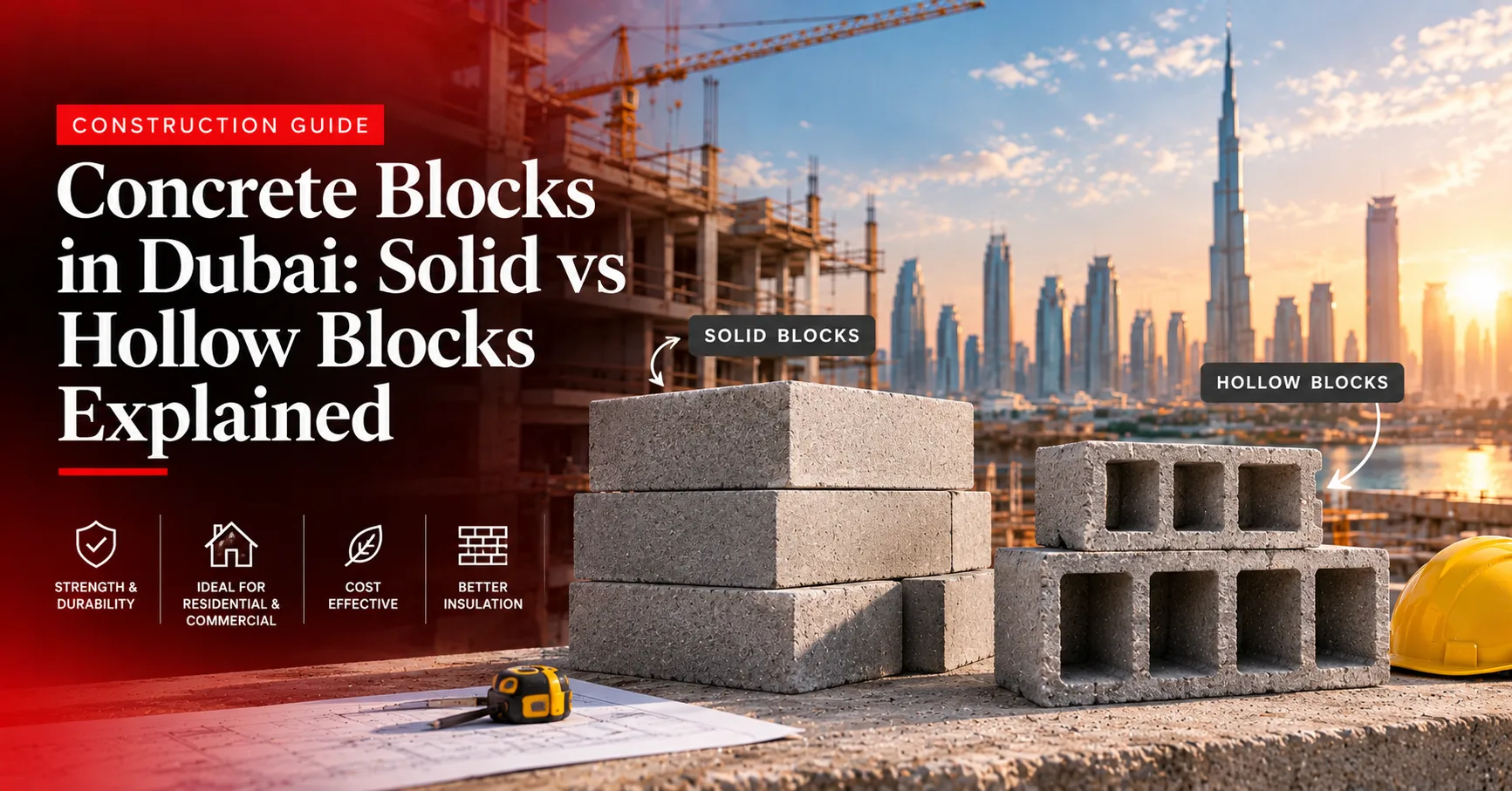
Solid concrete blocks have a dense body with little or no large hollow space through the main section of the block.
Because more of the block consists of concrete material, solid blocks can be relatively heavier than hollow blocks of comparable dimensions.
They are commonly considered for applications where a dense masonry unit is required, depending on the project design and specification.
Common Applications of Solid Blocks
Solid concrete blocks may be used for:
- Masonry walls
- Boundary and partition walls
- Foundation-related masonry applications where specified
- Heavy-duty construction requirements
- Areas where a denser block is preferred
The exact suitability depends on the block specification and the requirements of the construction project.
When purchasing solid blocks, contractors should confirm the required dimensions, strength, density, quantity, and delivery requirements before placing a larger order.
What Are Hollow Concrete Blocks?
Hollow concrete blocks are designed with hollow spaces within the block.
These openings reduce the amount of concrete material used in the unit and can make the blocks lighter and easier to handle than comparable solid units.
Hollow blocks are widely used in masonry and wall construction where the block design is appropriate for the application.
Common Applications of Hollow Blocks
Hollow concrete blocks may be used for:
- External and internal walls
- Partition walls
- General masonry construction
- Residential construction
- Commercial construction
- Selected non-load-bearing applications
The use of hollow blocks should always follow the project’s engineering and construction specifications.
The required dimensions, density, strength, and configuration should also be confirmed before procurement.
Solid vs Hollow Concrete Blocks: Key Differences
The most important difference is the internal structure.
A solid block is largely filled with concrete, while a hollow block contains designed cavities.
This difference can affect several practical characteristics.
Weight
Solid blocks generally contain more material and can therefore be heavier than hollow blocks of similar dimensions.
Hollow blocks have internal cavities, which can reduce their overall weight and make handling easier in suitable applications.
However, actual weight depends on the block’s dimensions, density, manufacturing method, and product specification.
Handling and Installation
Because hollow blocks can be lighter, workers may find them easier to move and position during certain masonry operations.
Solid blocks can require more handling effort because of their greater material content and weight.
However, actual handling requirements depend on block size, density, site conditions, and the specific product.
Material Consumption
The internal design of a hollow block means less concrete material may be required to manufacture a unit compared with a similar-sized solid block.
This can make hollow blocks useful where the construction design permits their use and reduced unit weight is beneficial.
For procurement teams, the block design can therefore be one of several factors to consider when comparing suitable options for a project.
Wall Construction
Both solid and hollow blocks can be used for wall construction, but the appropriate choice depends on the wall design.
A contractor should not select a block simply because it is lighter or more readily available.
The required block type, dimensions, strength, density, and other characteristics should be confirmed against the project specification.
Service Installations
Hollow block construction can sometimes provide space that may be useful when planning certain building services, depending on the wall system and design.
However, openings or modifications should not be made without considering the wall’s structural and functional requirements.
Any changes to masonry units should follow the applicable construction method and project requirements.
Are Hollow Blocks Stronger Than Solid Blocks?
It is not accurate to say that one type is always stronger than the other.
The performance of a concrete block depends on factors such as its composition, density, dimensions, manufacturing process, curing, and specified strength.
A hollow block can be manufactured to meet specific strength requirements, while solid blocks can also be produced for different levels of performance.
Therefore, contractors should compare the specified strength and product standard rather than assuming that a solid block is automatically stronger simply because it contains more material.
For a particular construction project, the engineer or project specification should determine the required block characteristics.
Which Concrete Block Should You Choose?
The choice between solid and hollow blocks depends on the application.
For General Wall Construction
Hollow blocks can be suitable for various wall construction applications where their dimensions and performance meet the project requirements.
They can provide practical handling advantages during construction.
However, the required block should always be confirmed against the wall design and project specification.
For Dense Masonry Requirements
Solid blocks may be considered where a denser masonry unit is required by the design or project specification.
Their higher material content can be useful for applications where the characteristics of a solid unit are required.
For Residential Projects
Residential projects may use both solid and hollow blocks depending on the wall type, structural design, partition requirements, and project specification.
The correct choice should be made according to the specific application rather than treating one block as suitable for every part of a building.
For Commercial and Industrial Projects
Commercial and industrial projects can have more detailed material specifications.
Block selection may depend on wall performance, dimensions, strength requirements, project standards, fire-related requirements, and the intended construction system.
For these projects, procurement teams should confirm the required block specifications before ordering larger quantities.
Factors to Consider When Buying Concrete Blocks in Dubai
If you are purchasing concrete blocks in Dubai, the type of block is only one part of the decision.
1. Block Type
First confirm whether the project requires solid or hollow blocks.
Do not assume that both can be substituted for one another without approval.
2. Dimensions
Block dimensions should match the project’s drawings and masonry requirements.
Using the wrong size can affect wall dimensions, material calculations, and construction productivity.
3. Strength Requirements
Check the required compressive strength or other specified performance characteristics.
For professional construction projects, the required strength should come from the project specification or relevant technical documentation.
4. Quantity
Estimate the required number of blocks based on wall area, block dimensions, openings, wastage allowance, and construction requirements.
For large projects, material planning should also account for different construction stages.
5. Product Consistency
Consistent block dimensions and quality can make masonry work easier and help maintain a uniform finished wall.
Procurement teams should communicate the required specification clearly to the supplier.
6. Delivery
Concrete blocks are bulky construction materials, so delivery planning is important.
Before ordering, confirm the project location, quantity, delivery schedule, unloading arrangements, and site access.
This becomes particularly important for projects where large quantities of blocks are required within a specific construction window.
Buying Concrete Blocks for Projects in Dubai
Dubai construction projects range from residential villas and apartment buildings to commercial properties, warehouses, industrial facilities, and infrastructure developments.
Each project can have different masonry requirements.
For smaller residential projects, contractors may require a combination of block types for different walls and applications.
Larger commercial or industrial projects may require scheduled deliveries to maintain the construction programme.
This is why working with a concrete block supplier in Dubai that can understand the project’s quantity and delivery requirements can simplify procurement.
Falcon Fame Trading supports construction material procurement from its base in Al Quoz Industrial Area 3, Dubai, and supplies solid and hollow concrete blocks along with several other material categories.
For block requirements, contractors can provide the required block type, dimensions, quantity, project location, and expected delivery schedule so the supply requirement can be discussed clearly.
Why Supplier Selection Matters
The supplier you choose can affect more than the purchase price.
A construction material supplier should be able to provide clear information about the available block types, dimensions, quantities, and delivery arrangements.
When comparing suppliers, consider:
- Availability of the required block type
- Product dimensions
- Applicable specifications
- Supply capacity
- Delivery capability
- Project location
- Quantity requirements
- Communication and response time
For larger construction projects, it can also be useful to discuss future requirements with the supplier instead of treating every delivery as a separate last-minute order.
A supplier with multiple construction material categories can also be useful when blocks are being procured alongside cement, dry mix, aggregates, sand bags, or other site requirements.
Concrete Blocks from Falcon Fame Trading
Falcon Fame Trading supplies solid and hollow concrete blocks as part of its construction material range in Dubai.
The company works with contractors, developers, technical service providers, and other construction-related businesses on material procurement and delivery requirements.
Along with concrete blocks, its product range includes OPC, PLC, MC2/Masonry Cement, White Cement, dry mix and mortar, aggregates, sand bags, gypsum products, road base, cement boards, gypsum boards, and MDF boards.
Located in Al Quoz Industrial Area 3, Dubai, Falcon Fame Trading has 36+ years of experience in construction material supply.
The company also operates with 30+ delivery vehicles, delivery capacity from 3 CBM to 45 CBM, and 24/7 delivery operations, supporting different project and delivery requirements across Dubai and the UAE.
For block requirements, providing the supplier with the required block type, dimensions, quantity, project location, and delivery schedule can help make the procurement process more straightforward.
How to Plan Your Block Requirement
Before ordering concrete blocks, prepare a basic material requirement based on the construction drawings and site plan.
Consider the total wall area, block dimensions, doors and window openings, expected wastage, and the construction schedule.
For larger projects, divide the requirement into planned deliveries where appropriate.
This can help prevent excessive material storage at the site while ensuring that blocks are available when the masonry team needs them.
The supplier should also be informed about site access and unloading conditions, particularly when deliveries are being made to busy construction locations.
For contractors working with Falcon Fame Trading, sharing these details in advance can help the team understand the required quantity and delivery arrangement more clearly.
Solid or Hollow: What Matters Most?
The choice between solid and hollow concrete blocks should ultimately be based on the project’s requirements.
Solid blocks can provide a dense masonry unit and may be appropriate for applications where that characteristic is specified.
Hollow blocks can offer reduced unit weight and practical handling advantages in suitable wall construction applications.
Neither option should automatically be treated as the universal choice.
The correct block depends on the wall design, required performance, dimensions, construction method, and project specification.
For this reason, contractors should confirm the required block type before placing a large material order.
Conclusion
Solid and hollow concrete blocks are both useful masonry products, but their different internal structures make them suitable for different construction requirements.
Solid blocks contain a denser body and can be selected where a solid masonry unit is required. Hollow blocks contain designed cavities that can reduce unit weight and provide practical handling benefits for suitable applications.
When purchasing concrete blocks in Dubai, contractors and procurement teams should consider the block type, dimensions, strength requirements, quantity, product consistency, delivery arrangements, and project specifications.
Falcon Fame Trading supplies solid and hollow concrete blocks along with cement, dry mix, aggregates, sand bags, gypsum products, road base, and construction boards.
With 36+ years of experience, 30+ delivery vehicles, 3–45 CBM delivery capacity, and 24/7 operational support, Falcon Fame Trading supports construction material procurement and delivery requirements across Dubai and the UAE according to project needs.
By sharing the project requirements and delivery details in advance, construction teams can plan their block procurement more efficiently.
FAQs
1. What is the difference between solid and hollow concrete blocks?
Solid concrete blocks have a dense body with little or no large internal cavity, while hollow blocks contain designed openings through the block. This difference can affect weight, handling, and suitability for different wall applications.
2. Are hollow concrete blocks suitable for building walls?
Yes, hollow concrete blocks can be used for various wall construction applications when they meet the project’s required specifications. The appropriate block type should be confirmed based on the wall design and intended use.
3. Are solid concrete blocks stronger than hollow blocks?
Not necessarily. Block performance depends on factors such as material composition, density, manufacturing, dimensions, and specified strength. The required strength should be checked against the project specification rather than assumed from the block’s appearance.
4. How do I choose between solid and hollow blocks?
Consider the wall type, project design, required strength, block dimensions, handling requirements, and applicable project specifications. The engineer or project documentation should guide the final selection for professional projects.
5. Where can I buy concrete blocks in Dubai?
Falcon Fame Trading supplies solid and hollow concrete blocks in Dubai, along with cement, dry mix, aggregates, sand bags, gypsum products, road base, and construction boards. You can share your required block type, quantity, project location, and delivery schedule with the supplier.