Hollow Blocks in DubaiWhen planning masonry work, contractors often need to decide whether hollow blocks or solid blocks are more suitable for a particular application. Both are commonly used concrete masonry units, but their internal structure, weight, handling characteristics, and suitability for different wall systems can vary.
For contractors searching for hollow blocks in Dubai, understanding these differences can make material procurement more straightforward. The right choice should be based on the wall design, required specifications, project application, quantity, and construction method rather than simply choosing the block that is cheaper or easier to source.
Concrete masonry units can be manufactured in both hollow and solid configurations, with different sizes, densities, strengths, and specifications available for different construction requirements. Industry guidance also makes clear that both hollow and solid units can be used in loadbearing applications when they meet the applicable requirements and project design.
What Are Hollow Blocks?
Hollow concrete blocks contain designed openings or cavities within the unit. These cavities reduce the amount of concrete material in the block compared with a solid unit of similar overall dimensions.
The number, size, and arrangement of the cavities can vary depending on the block design and manufacturer. Hollow units typically use face shells and internal webs to maintain the required shape and structural characteristics.
Because they contain less concrete material than a comparable solid configuration, hollow blocks can have a lower unit weight. This can make them easier to handle and position in suitable construction applications.
Hollow blocks are used for different types of masonry and wall construction, but their suitability should always be checked against the project’s drawings, specifications, and required performance.
What Are Solid Blocks?
Solid concrete blocks contain a much greater proportion of solid material throughout their cross-section.
Because they contain more concrete material, solid blocks can generally be heavier than comparable hollow units. Their actual weight still depends on factors such as dimensions, density, aggregate type, and manufacturing specifications.
Solid blocks can be used in different masonry applications where their characteristics meet the project requirements. However, the term “solid” does not automatically mean that a block is better or stronger for every construction situation.
The correct choice should always be based on the requirements of the wall and the specifications provided for the project.
Hollow Blocks vs Solid Blocks: The Main Difference
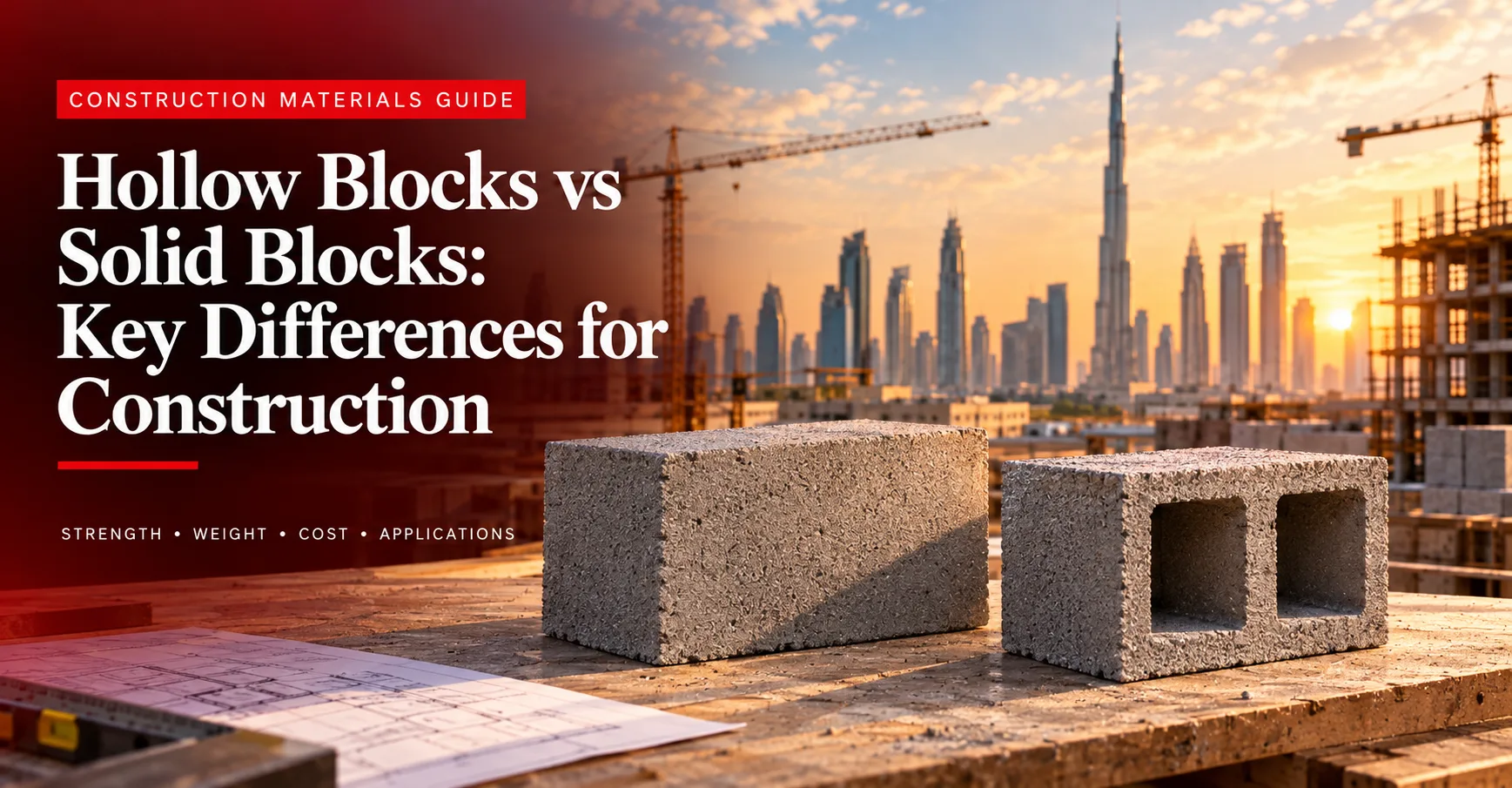
The most obvious difference between hollow and solid blocks is their internal configuration.
A hollow block contains designed cavities, while a solid block contains substantially more concrete throughout its cross-section. This difference can influence several practical aspects of construction, including:
- Unit weight
- Handling
- Material consumption
- Transportation
- Installation
- Wall construction
- Site logistics
However, contractors should avoid making general assumptions about performance based only on whether a block is hollow or solid.
Concrete masonry units are available in different dimensions, densities, configurations, and strength levels. For example, ASTM C90 covers loadbearing concrete masonry units that may be manufactured as either hollow or solid units.
Weight and Handling
One of the practical differences contractors usually notice is the weight of individual blocks.
Because hollow blocks contain internal cavities, they generally use less concrete material than a comparable solid configuration. This can result in a lower unit weight and may make handling more convenient in suitable applications.
Solid blocks contain a greater proportion of concrete and can therefore be heavier.
The actual weight of a block should still be confirmed from the supplier or product specification. Dimensions, density, aggregate type, and manufacturing method can all affect the final weight.
For larger projects, this information can also be useful when planning labour, material movement, unloading, and delivery requirements.
Material Use
The internal configuration of the block also affects the amount of concrete material contained in each unit.
A hollow block uses face shells and internal webs to create the masonry unit while maintaining cavities inside the block. A solid block contains a greater proportion of concrete through its cross-section.
This difference can affect manufacturing, transportation, handling, and the weight of the finished masonry system.
For contractors managing large quantities of concrete blocks, these practical factors can become important when planning procurement and material movement at the site.
Are Solid Blocks Always Stronger?
Not necessarily.
It is easy to assume that a solid block must always be stronger because it contains more concrete. However, the performance of a concrete masonry unit depends on several factors, including its material composition, density, manufacturing process, dimensions, curing, and specified compressive strength.
Industry guidance confirms that concrete masonry units meeting applicable specifications can be manufactured as either hollow or solid and can be used for different applications depending on their specified properties and the wall design.
So instead of asking whether hollow or solid blocks are “stronger” in general, contractors should ask:
What strength and performance does the project require, and which available block meets that specification?
That is a more practical approach to block selection.
Hollow Blocks for Construction
Hollow blocks can be suitable for a variety of wall construction requirements when their dimensions and performance match the project specification.
Their potentially lower unit weight can provide practical benefits during handling and installation. Depending on the project design, they may be considered for applications such as:
- Internal wall construction
- Partition walls
- Residential masonry
- Commercial construction
- General building work
- Selected nonloadbearing applications
- Other applications specified by the project
The exact application should always be confirmed through the project’s drawings and technical requirements.
Solid Blocks for Construction
Solid blocks can be considered where a denser concrete masonry unit is required or where the project specification calls for a solid configuration.
Depending on the design, they may be used for:
- Masonry walls
- Boundary walls
- Selected heavy-duty applications
- General construction
- Applications where solid units are specified
However, the specific use depends on the construction design, block specification, and required performance.
A contractor should not assume that every wall needs a solid block simply because it contains more concrete.
What About Loadbearing Walls?
Loadbearing construction requires particular attention because the block is only one component of the complete masonry system.
The wall design, masonry unit strength, mortar, reinforcement where required, grout, dimensions, and other construction details can all contribute to the final performance of the wall.
Industry guidance explains that concrete masonry units, mortar, grout, and reinforcement work together as part of the overall masonry system.
Therefore, loadbearing walls should always follow the approved structural design and specified material requirements.
The decision should not be based simply on whether a block is solid or hollow.
Hollow Blocks and Solid Blocks in Dubai Construction
Construction requirements in Dubai can vary considerably depending on the project.
A residential villa, commercial building, warehouse, industrial facility, boundary wall, or renovation project may require different types, sizes, densities, or strengths of concrete blocks.
For example, a contractor working on internal partitions may have different requirements from one constructing a boundary wall or another masonry element.
This is why there is no single block that is suitable for every project.
When sourcing hollow blocks in Dubai, contractors should first confirm the required block type and specification for the particular wall or construction application.
Working with a supplier that can understand the project requirement and coordinate material supply can also make procurement easier, particularly for larger construction sites.
Which Block Is Easier to Handle?
In general, a lighter unit can be easier to move and position manually.
Since hollow blocks contain internal cavities, they can have a lower unit weight than a comparable solid block. This can provide practical handling advantages in suitable applications.
However, actual handling depends on several factors, including:
- Block dimensions
- Unit density
- Number of blocks
- Site conditions
- Lifting method
- Masonry technique
- Labour availability
- Equipment available at the site
For this reason, handling convenience should be considered as one factor rather than the only reason for selecting a block.
Do Hollow Blocks Save Material?
The hollow configuration means that less concrete material is contained within the individual unit compared with a similarly sized solid configuration.
However, this does not automatically mean that using hollow blocks will always result in a lower overall project cost.
The total masonry cost can depend on:
- Block price
- Required quantity
- Wall design
- Mortar consumption
- Transportation
- Labour
- Handling
- Installation method
- Project specifications
For larger projects, contractors should compare the complete material and delivery requirement instead of looking only at the price of one block.
Transportation and Delivery Considerations
Concrete blocks are bulky construction materials, so transportation is an important part of procurement planning.
When a project requires a large number of blocks, both the weight and volume of the order can affect delivery planning, unloading, and site storage.
Hollow blocks may offer practical weight advantages because of their internal cavities, while solid blocks contain more material per unit.
For larger projects, contractors should discuss the required quantity, delivery frequency, project location, unloading conditions, and expected construction schedule with the supplier before placing the order.
This is particularly important when block deliveries need to be coordinated with other construction materials.
How to Choose Between Hollow and Solid Blocks
Instead of asking which block is universally better, start with the project requirements.
Check the Wall Design
Identify whether the wall is internal, external, partition, boundary, loadbearing, or another type.
Check the Specification
Review the project drawings and technical documents for the required block type, dimensions, strength, density, and other characteristics.
Check the Dimensions
Make sure the selected block matches the required wall thickness and masonry system.
Check Strength Requirements
Confirm the specified compressive strength rather than assuming that a solid block is automatically stronger.
Check Weight
If handling and transportation are important considerations, compare the actual unit weight of the available products.
Check Quantity
Calculate the required quantity based on wall area, openings, block dimensions, wastage allowance, and project requirements.
Check Delivery
Confirm whether the supplier can provide the required quantity at the project location and according to the required schedule.
What Should You Ask a Block Supplier?
Before placing an order, contractors can ask the supplier a few practical questions:
- Do you supply both hollow and solid blocks?
- What dimensions are available?
- What strength specifications are available?
- What is the unit weight?
- What quantity can you supply?
- Which applications are the available blocks suitable for?
- Can you deliver to the project location?
- What delivery schedule can you support?
Providing complete project information helps the supplier understand the requirement and provide a more relevant quotation.
Buying Hollow Blocks in Dubai
When searching for hollow blocks in Dubai, contractors should look beyond the product name.
A useful enquiry should include the required block type, dimensions, quantity, project location, and delivery requirements.
For larger construction projects, it can also be useful to discuss expected future requirements. This allows block procurement to be planned around the construction schedule rather than handled only when the site is running short of materials.
Supplier capability is another important consideration. A supplier may offer the required block but may not be able to support the quantity, delivery schedule, or wider material requirements of a project.
For contractors managing multiple material requirements, working with a supplier that offers several construction material categories can simplify procurement and coordination.
Hollow and Solid Blocks from FALCON FAME TRADING
FALCON FAME TRADING supplies both solid and hollow concrete blocks as part of its construction material range in Dubai.
The company supports contractors, developers, technical service providers, and other construction-related businesses with construction material procurement and delivery requirements.
Along with concrete blocks, FALCON FAME TRADING supplies:
- OPC Cement
- PLC Cement
- MC2/Masonry Cement
- White Cement
- Dry Mix and Mortar
- Construction Aggregates
- Sand Bags
- Gypsum Powder and Gypsum Products
- Road Base
- Cement Boards
- Gypsum Boards
- MDF Boards
Located in Al Quoz Industrial Area 3, Dubai, FALCON FAME TRADING has 36+ years of experience in construction material supply and operates with 30+ delivery vehicles and 24/7 delivery operations.
Its delivery capability ranges from 3 CBM to 45 CBM, supporting different material requirements and project scales.
For contractors looking for hollow or solid blocks, sharing the required block type, dimensions, quantity, project location, and expected delivery schedule can help FALCON FAME TRADING understand the requirement and coordinate the supply accordingly.
Planning Block Procurement for a Larger Project?
For a larger construction project, block procurement should be planned alongside the overall material schedule.
Instead of waiting until the site needs additional blocks, contractors can estimate upcoming requirements and discuss delivery planning with the supplier in advance.
This can help coordinate block supply with masonry work, storage capacity, site access, and other material deliveries.
With a broader construction material range and delivery support, FALCON FAME TRADING can also be considered when a project requires blocks alongside cement, dry mix, aggregates, sand, road base, or other construction materials.
A Practical Way to Decide
If you are still unsure whether your project requires hollow or solid blocks, follow a simple process:
First: Check the project specification.
Second: Identify the wall type and intended application.
Third: Confirm the required dimensions and strength.
Fourth: Compare the actual product specifications available from suppliers.
Fifth: Confirm quantity, delivery requirements, and site conditions.
This approach is more reliable than choosing a block based only on price, weight, or general market preference.
Conclusion
Hollow and solid blocks are both established concrete masonry products, but their different internal structures give them different practical characteristics.
Hollow blocks contain designed cavities and can offer weight and handling advantages in suitable applications. Solid blocks contain a greater proportion of concrete and may be selected where a solid masonry unit is specified.
Neither should automatically be considered the right choice for every project. The appropriate selection depends on the wall design, project specification, block dimensions, required strength, weight, quantity, and construction requirements.
For contractors looking for hollow blocks in Dubai, it is important to confirm the exact material specification before placing an order.
FALCON FAME TRADING supplies both hollow and solid concrete blocks along with a wide range of construction materials across Dubai and the UAE. With 36+ years of experience, 30+ delivery vehicles, and 24/7 delivery operations, the company supports construction material procurement for different project requirements.
Providing clear project details before ordering can make the block procurement and delivery process more organised and straightforward.
Frequently Asked Questions
1. What is the main difference between hollow and solid blocks?
The main difference is their internal structure. Hollow blocks contain designed cavities, while solid blocks contain a much greater proportion of solid material throughout their cross-section.
2. Are hollow blocks suitable for construction?
Yes. Hollow concrete masonry units can be used in various construction applications when their specifications meet the requirements of the project. Their suitability depends on the wall design, required performance, and applicable project specifications.
3. Are solid blocks stronger than hollow blocks?
Not automatically. Strength depends on factors such as the block’s material, density, manufacturing, dimensions, and specified compressive strength. The required performance should be checked against the project specification.
4. Which is lighter, hollow blocks or solid blocks?
A hollow block will generally contain less concrete material than a comparable solid block and can therefore have a lower unit weight. However, actual weight varies according to dimensions, density, aggregate type, and product specification.
5. Where can I buy hollow blocks in Dubai?
FALCON FAME TRADING supplies hollow and solid concrete blocks in Dubai, along with cement, dry mix, aggregates, sand bags, gypsum products, road base, and other construction materials. Contractors can share the required block type, dimensions, quantity, project location, and delivery schedule to discuss their material requirement.